
The term “vibe coding” has gone fromAndrej Karpathy tweet to legitimate development philosophy in about a year. The idea is simple: describe what you want in plain English, and let AI write the code. But how that actually plays out depends a lot on who you are, what you’re building, and how deep your technical background goes.
I sat down withCharlie Apigian, PhD, to compare notes. Charlie is the founder ofData Inspire, a data and AI strategy firm, a former Professor of Data Science and Analytics atBelmont University, former Executive Director of theBelmont Data Collaborative, and the Lead Data and AI Strategist forLBMC. He’s also the author ofAI Reimagined, released earlier this year. With 25+ years in data science and multiple Nashville Technology Council awards (includingData Scientist of the Year), Charlie brings a perspective grounded in enterprise strategy and academia. I come at this from the product management and AI newsletter side, spending my days vibe coding in Cursor and writing about what works (and what doesn’t) for Handy AI.
We both think vibe coding is going to fundamentally change who builds software. But we don’t agree on everything. Here’s our conversation.
How did you first encounter vibe coding, and what was your initial reaction?
Charlie: My experience with vibe coding is a little different than what people are experiencing today. I have over 25 years of programming experience in R and Python. I was not looking to start coding, but instead, enhance and accelerate my coding.
My old way of coding was to scour Stack Overflow to create code, then to use my code as my template for future projects. I use AI and projects within AI, specifically Claude projects, as a repository for my old code, and then that is my reference for future code. It has been the biggest game changer in productivity and enhancement of my models and applications. I’m also learning things like data engineering and cloud infrastructure, which in the past was off limits for me.
Jake: Karpathy’s tweet is where I saw it first. Hard to fathom that was only one year ago. My initial reaction to the term was pretty intense hatred; it felt a bit too Gen Z and a bit too non-serious.
The term has since spread like wildfire and I’m (a little) more comfortable using it now. I still gravitate more towards terms like AI-assisted coding which isn’t as fancy, but makes me feel a little less silly. If I’m being honest, I’ve never quite understood the term to begin with. I’m a bit more in the weeds with my coding agent than others and don’t particularly feel like I’m vibing. Something like “flow coding” feels more appropriate. Maybe I need to loosen up.
I was pretty early with using the typical copy-and-paste-from-ChatGPT for AI coding that was common in the earlier days of the technology. When Cursor came out I was a super early adopter, and pretty quickly saw where this was headed and knew I need to get comfortable with it. The last few model releases have affirmed I made the right move.
What does your current vibe coding workflow look like?
Charlie: I have fully embraced agentic engineering (first termed by Peter Steinberger, OpenClaw - now OpenAI). Let’s stop calling it vibe coding; I use it from the planning to the outlining and the execution of my code. I have used several different editors, including Pi Charm, Cursor, and now Antigravity from Google. I like Antigravity because I wanted to learn the Google Cloud Platform environment, and I felt it had the best integration with it.
I normally still start with my own code and ask it specific questions, but I am noticing more and more I’m letting AI take over the planning And then I am fine-tuning my code and my models and iterating several times over. I am noticing better predictive results in my modeling, and I am doing my work in a quarter of the time.
Lex Friedman podcast where I heard him mention Agentic Engineering.
Jake: (“Agentic engineering” is definitely a more attractive term… may run with that)
I’m still mostly on Cursor. I’ve got a workspace directory set up for my full-time job (and others for misc side projects) and work within that directory with the agent. Typically that’s making scripts to run small tasks, prototyping products/interfaces, and running analysis.
I think Cursor has the best agent harness in the world right now; using 5.3 Codex or Gemini 3.1 Pro feels much more effective there compared to their native apps.
I’ve been experimenting with Codex for various things, but it hasn’t sold me yet on deep coding work. There’s a level of obfuscation there to make it more appealing to casual users that I don’t love. Other harnesses (Claude Code, Antigravity) I’ve been largely unimpressed by or there’s one or two quirks I don’t like; I’ve gotten too comfortable with Cursor.
Let’s talk tools. Cursor, Codex, Claude Code... what’s your go-to and why?
Charlie: The one constant is change for me. I love to try all of the tools and have tried them all.
I first started with PyCharm with Claude Plug-In. I then went to Cursor and loved the integration within that editor. When I wanted to learn the Google cloud platform, I switched to anti-gravity, and that is my current editor of choice. Don’t worry; I’ll switch to something else next month, but right now I am enjoying anti-gravity as my code editor.
The editor is not as important as the AI assistant. Right now Anthropic, Claude Opus 4.6, and Sonnet 4.6 are winning the day for me. Sonnet 4.6, which was just recently released, is faster and seems to give more solid coding scripts than Opus and are better than Gemini 3.0 Pro. I have not used OpenAI’s Codex in a while and do not plan to.
Jake: Among the chaos of tools I’ve personally found it helpful to pitch my tent with one particular one, and that’s been Cursor. When a new tool comes out I’ll usually do my due diligence with it to make sure I stay on top of the landscape, but I always circle back to Cursor as my one true love. I’ve also grown to love Claude Cowork for one-off business tasks; Opus 3.6 in that harness is something special (if only their usage limits were a bit more generous…).
Fully agree with Charlie’s comment on the AI assistant being more important overall; I’m a big “use Codex for backend and Opus for frontend” guy (and sometimes Gemini 3.1 Pro to spice up some UX). Being able to switch between models is probably the #1 reason I stick with Cursor.
I’d also add that the agentic harness (that is, the way a platform like Cursor/Claude Code instructs the agentic model to act) is possibly even more important. Cursor has a huge lead here; especially a fan of how they instruct sub-agents. It’s really starting to pay off with their focus on cloud agent tooling, where the harness is becoming even more important than the user’s initial prompt.
Charlie, you gotta try Codex 5.3 Extra High! It’s honestly a crazy model for backend work and things requiring a deep understanding of a big repo. Its auto-contextualizing is some serious stuff.
Who is vibe coding actually for? Is it just developers, or can non-technical people genuinely build production software this way?
Charlie: Agentic engineering is for everyone. First, it is for the non-technical person that wants to start their AI journey and learn how to build their own applications. If you are curious and can ask good questions, you can learn how to code just with AI.
For the developer, it is not an option. It is now a requirement. You are now competing against others that have this superpower, and you cannot say that you are a better coder than the AI agents out there. You + AI is always going to be better than you alone. For all of my developer friends out there, embrace it now and get good at using it. It will make you a better developer.
Jake: Two years ago it was for AI nerds. The models then were rudimentary and everything had a more “playground” feel to it. Countless folks were sharing their apps on social media and most were clunky at first glance (with sloppy code to match).
Since then, and especially in the past 3-6 months with the most recent generation of coding models, we’re in a completely different situation. I now recommend that absolutely everyone tries to become the “AI expert” at their respective companies to position themselves as retainable when the inevitable cuts come. We are past the point of resisting implementation with these systems. That (noble, at times) effort has passed. The decision-makers in the industry-at-large have chosen the path forward for everyone.
Now, to Charlie’s point, it’s especially important for software engineers to at least get familiar with agentic coding. The demand for engineers is rising, not lowering, and that’s because an engineer directing agents provides way higher value than a business manager directing agents. We are rapidly entering into a tech industry world where agent orchestration is becoming the most valuable position. Your ability to capitalize on this may make or break the future of your career.
There’s a lot of hype around vibe coding right now. What’s overhyped, and what’s underhyped?
Charlie: What is overhyped is that it is replacing the developer. It is replacing 80% of our code, but as we all know, the last 20% is the hardest part. It is predicting what the user wants. It is making sure that it is a good user experience. It is also making sure that the process and workflow makes sense.
AI continues to over-engineer and write too much code, which can be clunky, hard to debug, and slow. The overhyped and the underhyped part of vibe coding or agentic engineering is the human. We are still needed. I believe that and will always believe that we make the best products and AI can help us get there.
Jake: I think broadly agentic interfaces are overhyped. The concept of sitting down as a fancy, simplified SaaS dashboard and directing your agents in this way and that way isn’t something valuable right now. What’s valuable right now is getting to know the more technical tools. This sets you up for success in the present and in the future when the tools inevitably become more and more simplified. Knowing that the engine runs the car is great, but knowing how the engine works (and how to fix it!) is way better.
I agree with Charlie on the human element here. If I had to pick a specific product or model that I feel is underhyped, it’s probably Google’s more obscure research models (specifically the Genie 3 world model and Gemini Diffusion). DeepMind is (and always has been) a cracked research team, and I truly think both of these are a peek into the more distant future of AI tech. Check them out!
What role does understanding code play in vibe coding? Do you need to know how to program to do this well?
Charlie: You do not need to know how to code to get started, but to make beautiful applications that actually add value to you and your organization, it is good to know the code. AI will be a great partner, but at the end of the day you are responsible for your work. Therefore, embrace learning, and as you vibe code, ask questions to AI to learn what it is doing on your behalf. All of a sudden, you will be the one that understands the code and can take it to a finish line.
Jake: I’ll be a bit contrarian to Charlie’s measuredness here. Two years ago I’d say you should ask your agentic partner along the way to explain the code to you. Now I don’t think it matters as much, and I think in the near future it won’t matter at all.
Cursor recently gave their cloud agents the ability to use computers, enabling the agents to code a feature and then send a physical video demo to their human handlers for review. As a result, 30% of their code is now generated by cloud agents.
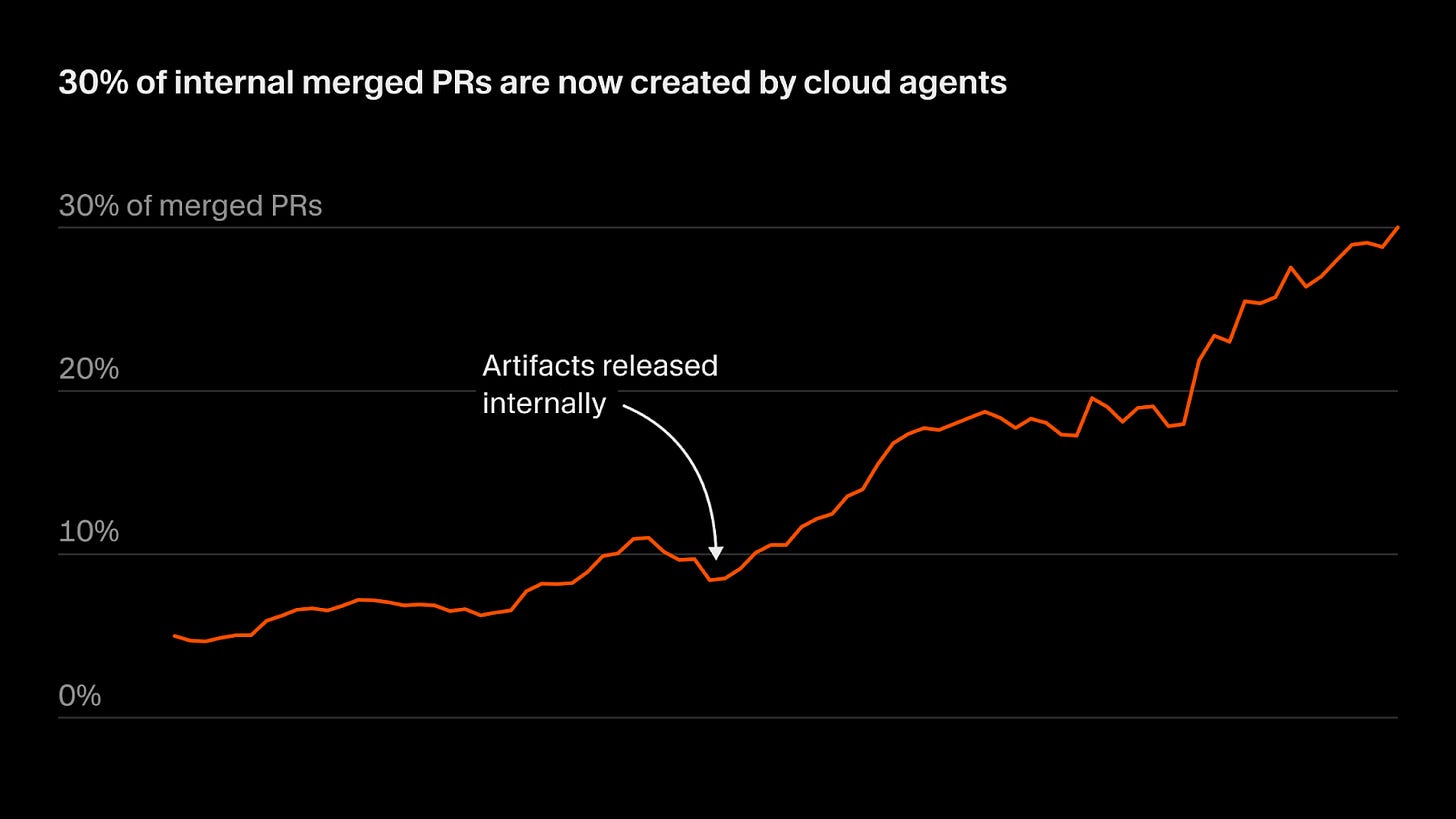
This is just the beginning of this kind of stuff. I think passing off coding tasks to cloud agents is absolutely the future of agentic engineering (evident also by Codex’s approach and Claude Code’s new Remote Control feature), and I think the natural conclusion is that the human handlers no longer care to look at the underlying code.
You both work in Nashville’s tech ecosystem. How do you see vibe coding impacting the local tech community and beyond?
Charlie: It does two things that are amazing:
- It opens up the world of development to everyone, and that is a good thing. It does not need to be the chosen few developers behind closed doors. Everyone should be part of the conversation.
- People are more curious and having better conversations about what tech and AI can do for you, and that starts with them just getting started with AI.
I fully embrace everyone. Let me repeat that: everyone should start vibe-coding today, even if it’s just to have a conversation. The people that will thrive in the age of AI will be those that understand processes and workflows. If you can also understand the technology, it makes you that much better and more relatable to future AI applications.
Jake: Nashville has an incredible opportunity with agentic engineering. For software creation, these tools have not just reduced the barrier to entry but demolished it entirely. This means that the wealth of industry experience Nashville has (in areas like music and healthcare) is now fully deployable in every sense of the word.
At Cursor Nashville’s first meetup, the best demos I saw were run by industry veterans that had never touched code in their life. They went from automating spreadsheets in Excel to building out full production apps with Cursor. If we can convince Nashvillians-at-large to just sit down, try these various tools, and get the prototypes flowing I think we could turn the city’s tech scene into something truly special.
Where do you think vibe coding goes from here? What does it look like in 2-3 years?
Charlie: I believe we have already moved past it, and it is why I embrace the idea of agentic engineering. We all will write differently. We all will research differently within the next year. One thing I can definitely not predict is two to three years from now, but for the next twelve months we will see a titanic shift in how we get work done. As I like to say, this next year is how we re-imagine the future in two to three years and make sure that it enhances what we do instead of replaces
Jake: I wholeheartedly agree with Charlie. We’re seeing countless companies openly admit that over 50% of their code internally is written, some 90%+, and that’s only going to continue. The number of friends that have come to me asking how to deal with their employers onboarding AI tools has skyrocketed just in the past few months.
It’s here. It’s happening. In 2-3 years I think we’re looking at a near complete transformation of how business was done 2-3 years prior.
What’s one piece of advice you’d give someone who wants to start vibe coding today?
Charlie: My advice never changes. It is to get informed and educated about AI, and the best way to get started is to start vibe coding today. Find a use case, understand your process, and identify how AI can enhance or accelerate that process. One use case turns into many, but you have to start somewhere, and that somewhere starts today.
Jake: I think Claude’s desktop app is a great entry point for all flavors of folks. If you’re more technical, open it up and switch over to the Claude Code tab. If you’re less technical, go to the Claude Cowork tab.
Both these modes in the desktop app offer an easy-to-jump-into first contact with an AI agent harness. From here, as you get more comfortable with how these agents work, you can ease into something like Cursor and go nuts with cloud agent workflows. Welcome to the future of work!
Charlie Apigian is the founder of Data Inspire, Lead data and AI strategist at LBMC and Acklen Avenue, a former professor, and the author of AI Reimagined: A Leader’s Guide to Think Different with Data. Connect with him onLinkedIn.
Jake Handy is a product manager, AI newsletter writer, and vibe coder. Subscribe toHandy AI for weekly AI updates and deep dives.