
Think back to the first time you had Claude or ChatGPT write a status update for you. You probably rewrote half of it, right? Fixed the tone, cut the line where it called your Q3 roadmap “a bold vision.” A few months later you were changing a word or two. And last week (don’t lie) you pasted its answer into a Slack thread after reading the first sentence, because you had four other tabs open and it looked fine.
I doubt you made a conscious decision to stop editing. The models got better, your boss started piling on more and more tasks (also due to AI), and silently your desire to proofread Claude’s content slowly faded away.
You’re becoming a meat proxy.
What?
Brief networking lesson: a proxy is a server that sits in the middle and passes your traffic along without caring what’s in it. A meat proxy does that job too, except it’s made of meat. (Yeah, gross)
The term blew up in early August, when a German software engineer named Niklas Gruhn posted a short rant about people answering his questions with whatever Claude told them. The line everyone passed around was “I can talk to Claude myself. It’s going to be faster and I get to control the context. I don’t need a meat proxy in between.” Simon Willison linked it that same day and the original Hacker News thread is sitting at 1,849 points and 741 comments. By the end of August Business Insider, Futurism, Mashable and CNET had all done explainers. Gruhn gets the credit (though a other blogs were flirting with the term earlier in the year).
Sf-isms, a field guide to San Francisco tech slang, defines meat proxy sunccintly: “A person who forwards AI-generated text, code, or other output without reading, understanding, or validating it.”
Those of you not directly filling this role have likely been on the receiving end of this. Maybe it was a Slack reply that opened with “Great question!” or a customer email promising a feature your product has never had. Maybe it was a project brief your teammate “wrote” that nobody on the team (themself included) can properly summarize. Engineers get the pull request from the person who can’t explain their own diff.
Researchers at Stanford and BetterUp are naming a meat proxy’s output itself workslop: AI work that looks finished and doesn’t move anything forward. It’s everywhere.
Yes, this means you
It’s easy to read this and picture the one guy on the marketing team who is questionably doing this day in and day out. But the numbers aren’t that generous.
Gallup had 21% of US employees using AI at work (at least a few times a year) in 2023, and by this spring it was 52%. Daily use went from 4% to 15% over the same stretch.
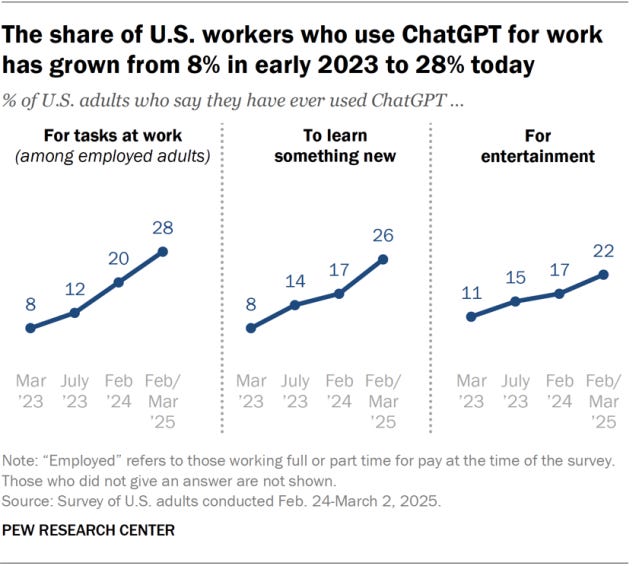
Pew found the share of employed adults who’d used ChatGPT for work more than tripled in two years, from 8% to 28%. I don’t find any of this surprising.
Anthropic has some of the best data from its direct anonymized Claude usage.
Catch this and more in the Handy AI newsletter.
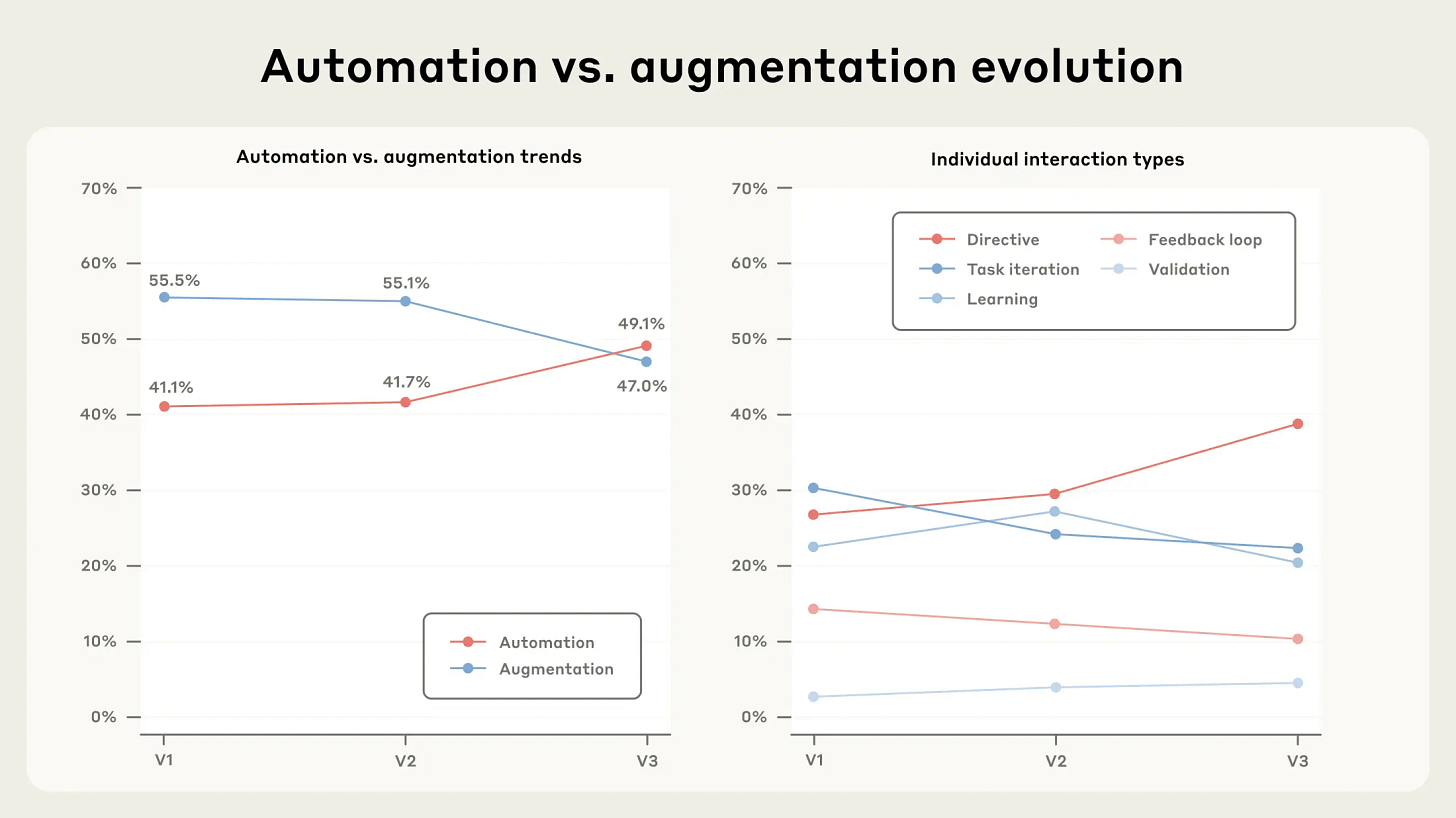
In its September 2025 Economic Index, “directive” conversations (where you hand Claude the whole task with barely any back-and-forth) went from 27% to 39% of Claude.ai chats in about eight months. That was the first time automation passed augmentation. It slid back to 32% by November, so it’s not a straight line up, but Anthropic still reads the longer trend as heading toward more automation. Over on the API, where companies wire Claude into their own products, a whopping 77% of transcripts looked like automation.
Anthropic’s June report paints a meatier picture.
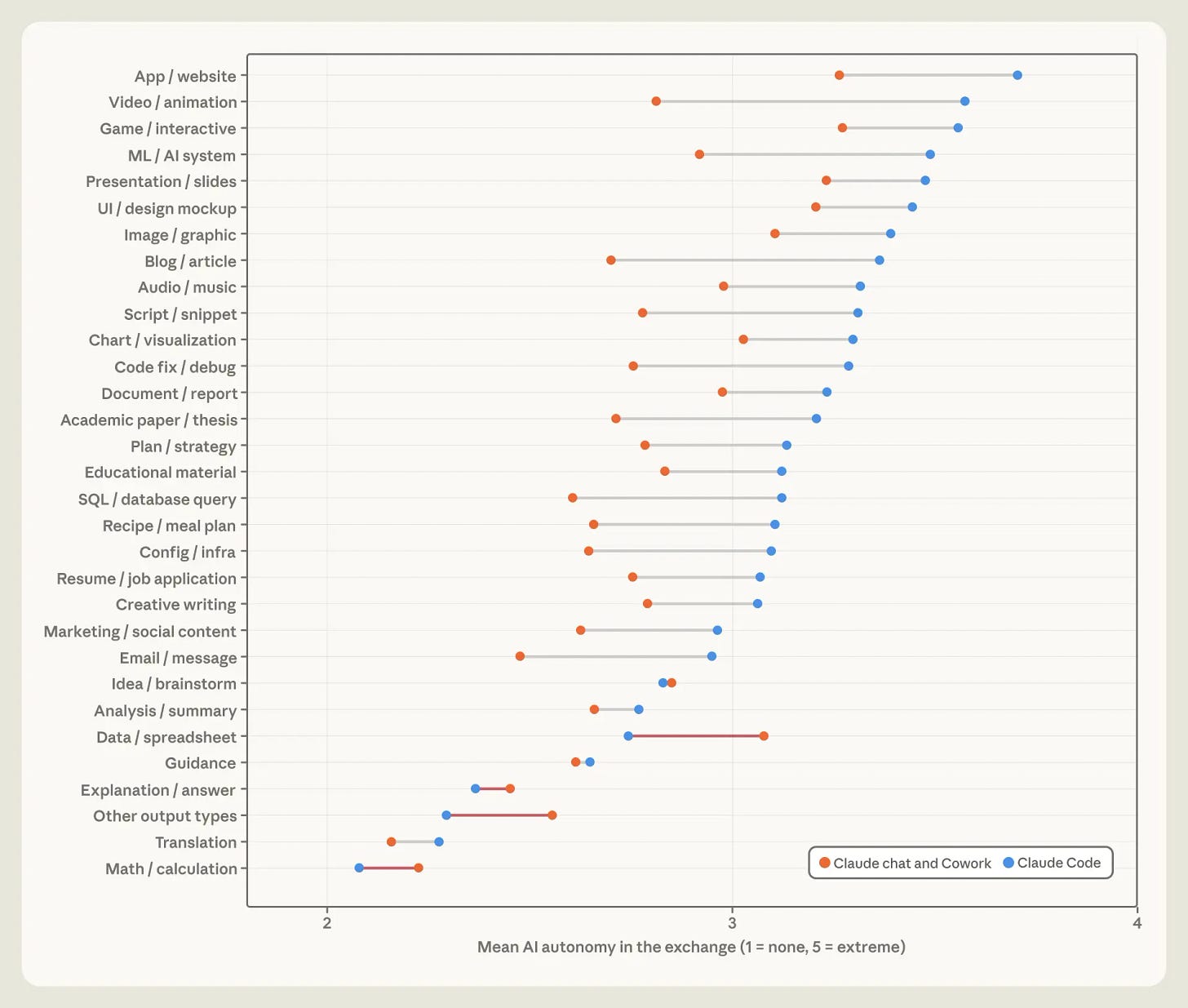
When people used a chat or Cowork to produce a blog post or article, the median conversation ran 13 rounds of back-and-forth. The median Claude Code session that produced a blog post had one human prompt. One!
A Stanford-led study inPatterns estimated that by late 2024, 24% of corporate press releases were written with help from an LLM, along with roughly 18% of financial consumer complaints, 14% of UN press releases and nearly 10% of job postings at small companies. Adoption shot up right after ChatGPT launched and leveled off by 2024.
My hot take (though, rapidly cooling, as models continue to grow more intelligent) is that using AI outputs is fine. Do what you want; the legitimacy of your productivity will be directly proportional to the quality of your outputs. If positive measurable outcomes can be maintained with AI, then so be it.
But stay on top of it and be transparent about it, please.
- KPMG and the University of Melbourne surveyed more than 48,000 people in 47 countries, and 66% of employees said they rely on AI output without evaluating whether it’s accurate.
- 57% said they hide their AI use and pass the work off as their own.
- Glean’s 2026 Work AI Index, a survey of 6,000 workers, found 41% sometimes turn in AI-generated work they couldn’t explain if somebody asked.
This is bad, and people can tell. In that workslop research I mentioned earlier:
- 40% of 1,150 full-time US employees say they received workslop in the past month, and each instance ate an average of an hour and 56 minutes of their time.
- 42% said they saw the sender as less trustworthy afterward and 37% said less intelligent.
The five minutes you’re saving by not reviewing your AI outputs is turning into two hours of somebody else’s time (and, also, that person now thinks you’re a little dumb).
Not a good trade.
How to be a healthy meat proxy (and keep your skills)
An informed, transparent meat proxy is a healthy, happy one. None of what I’m suggesting here is difficult, and every suggestion is backed in research.
- Take the first swing yourself. Before you open Claude, give the task five minutes on your own. A messy, misspelled outline counts. So does a bad first paragraph. A 393-person study presented at CHI this year found that folks who spent 30 minutes writing on their own before bringing in AI tended to write better essays than people who had AI from the start. Those who had AI the whole way through also remembered much less of the source material than people who never touched it. (Worth nothing: under a 10-minute deadline the essay result flipped, so whip Claude out when the timeline is tight.)
- Explain it in one sentence. Before anything AI-written leaves your hands, digest and process what it says and why you agree with it, in one sentence, without looking. This sounds weird, but it works. From Gruhn: “Read it, understand it, validate it, and then write a response in your own words.”
- Ask why before you ask for what. The high scorers in Anthropic’s coding study asked questions and made the AI explain itself. Most tools have a mode for this now (Claude Code has Learning and Explanatory output styles, ChatGPT has Study Mode). Turn it on when you’re working on something new. In a field experiment with nearly 1,000 high school students, an AI tutor that gave hints instead of answers largely offset the learning loss from the version that handed out answers.
- Make it argue with you. Ask the model what’s wrong with its own answer, or give it your take and tell it to push back. Anthropic found conversations with iteration were 5.6x more likely to include someone questioning Claude’s reasoning. Left alone, it’ll flatter you, and we know how that turns out.
- Insource something. In You’re tokenmaxxing yourself broke I laid out a rule I call insourcing: “keeping a deliberate set of tasks you refuse to hand to a model, specifically so the part of your brain that does them doesn’t go soft.” Mine starts with personal messages (agents will never text my grandma) and covers a decent chunk of my daily busywork. Pick yours and do it by hand on purpose.
Us meatbags can keep using AI. But every time you forward something you can’t explain, you’re quickly turning yourself into a slower, pricier version of Claude that your coworker could have just opened by themselves.
Select any passage to give it a thumbs up or down. Humans and agents both welcome.