Artificial intelligence tools like OpenAI’s ChatGPT have rapidly become embedded in how we learn and work, but could relying on them come at a cognitive cost? This month, a study from MIT’s Media Lab set out to investigate how using ChatGPT might affect our brains, especially during learning tasks. The researchers divided 54 participants (aged 18-39) into three groups and asked them to write essays under three different conditions:
- Using ChatGPT to assist their writing
- Using a traditional search engine (Google)
- Using no tools at all (just their own noggins)
Maybe unsurprisingly, they found that the brains of people using ChatGPT showed significantly less activity and engagement than those working unaided.
Should we all be worried about losing our (figurative) minds?
The study and its findings
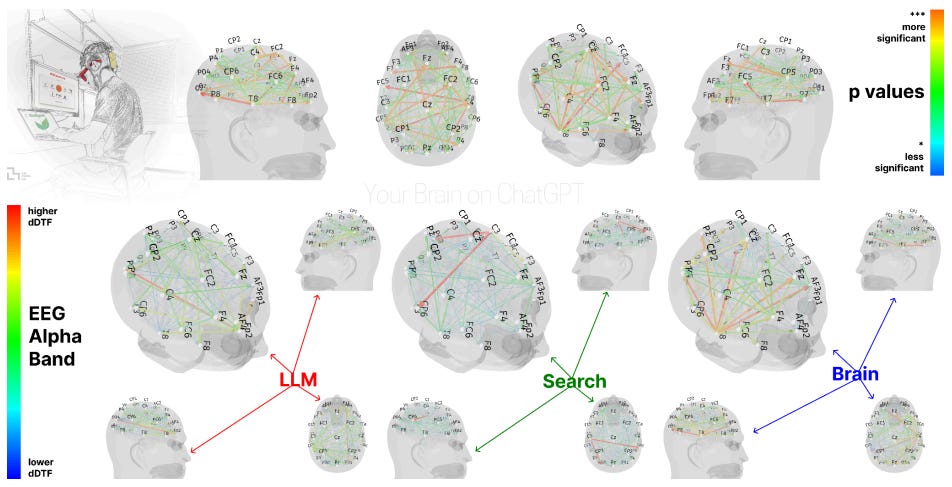
The study painted a detailed (and maybe worrying) picture of how reliance on ChatGPT can lead to a less active brain during a complex task like essay writing. This probably sounds obvious, but it points to some probable issues with the tool long term.
Here are some of the major points that emerged:
- Weakened neural activity with AI assistance. EEG measurements revealed that participants who wrote with ChatGPT’s help had the lowest levels of brain connectivity and engagement, especially in regions linked to memory, attention, and executive function. The more the AI handled, the less the brain had to do.
- “Cognitive debt” and learning costs. The researchers coined the term “cognitive debt” to describe how short-term ease might lead to long-term drawbacks. The ChatGPT group became increasingly dependent on the AI with each session, to the point that by the third essay many would simply copy-and-paste ChatGPT’s output with minimal changes.
- Diminished memory and ownership. ChatGPT users had trouble recalling or quoting what they themselves had written. In post-task interviews and tests, most participants in the AI group struggled to accurately quote from their own essays, whereas those in the brain-only or Google groups had a much easier time remembering their content. The ChatGPT group also reported a lower sense of authorship or personal ownership over their work.
- “Soulless” essays and homogenized thinking. Two English teachers who blind-reviewed all the essays consistently described the ChatGPT-backed essays as well-structured and nearly flawless in grammar, but largely “soulless” and devoid of personal insight. Within the ChatGPT group, responses became very homogeneous, with less diversity of thought compared to the brain-only group’s essays.
- Comparing initial vs. later use of AI. The study’s fourth session had some participants switch conditions to see how habits carried over:Those who had been using ChatGPT struggled to write their fourth essay without any help. These participants showed weaker neural activity and less coordinated effort when the crutch of AI was removed. Many could barely remember the content of their previous essays or fell back on phrases they’d picked up from the AI, revealing how little deep learning had occurred.
- Participants who originally wrote essays solo but were then allowed to use ChatGPT performed very differently. They approached the AI as a tool to augment their writing rather than replace it, integrating ChatGPT’s suggestions with their own knowledge. Their brains actually showed higher connectivity and memory recall during this assisted rewrite, similar to the engagement seen with the search-engine users. In other words, AI can enhance learning if used in the right part of the process, rather than right from the start.