Education is at an interesting (and terrifying) inflection point. Roughly two-thirds of U.S. teachers were using AI last year (up from 51% the year prior) and 70% of high school students said they used AI in that same window. Unfortunately, despite these rising usage rates, only 35% of district tech leaders report an active AI initiative.
Luckily, our educators are eager to learn. As of fall 2024, 48% of U.S. districts have trained teachers on AI, with intent to reach 74% by this fall. While you may assume that teachers and educators are outright rejecting the promise of AI systems, data as early as 2023 indicated that a massive 88% of teachers said ChatGPT has an overall positive impact.
Despite these datapoints and promises, getting in the groove of using AI in your work day can be challenging and feel overwhelming. This week, we’re starting off easy with an extensive look into how teachers and educators can (and should) be using ChatGPT. Next week, we’ll look at some more advanced workspace setups with programs like Cursor.
Everyday AI workspace: ChatGPT for education
It doesn’t take an AI expert to get the benefits of ChatGPT in your classroom or admin office. OpenAI built the bot for ease-of-use, and the platform since inception has added a crazy amount of additional functionality that’s perfect for educators.
If you’re using ChatGPT’s free mode, consider upgrading. The 20 bucks a month will give you access to more intelligent models that have more reliable and detailed responses, and will open up access to power user features like Deep Research and Agent Mode (more on that later).
ChatGPT for teachers
Instead of spending hours crafting differentiated content, they can now generate personalized learning paths and custom practice materials in minutes. Here’s some ideas to get started.
1. Lesson planning and brainstorming
Instead of asking "help me plan a lesson on photosynthesis," try something a bit more involved like:
I'm teaching 7th grade photosynthesis to a class of 28 students with mixed abilities. Three students are English learners, five have reading difficulties, and several are advanced. I need a 45-minute lesson plan that includes:

- A visual demonstration they can do at home
- Three differentiated activity options
- An assessment that works for all learning levels
- Connection to their prior unit on cellular respiration

Make it engaging and hands-on.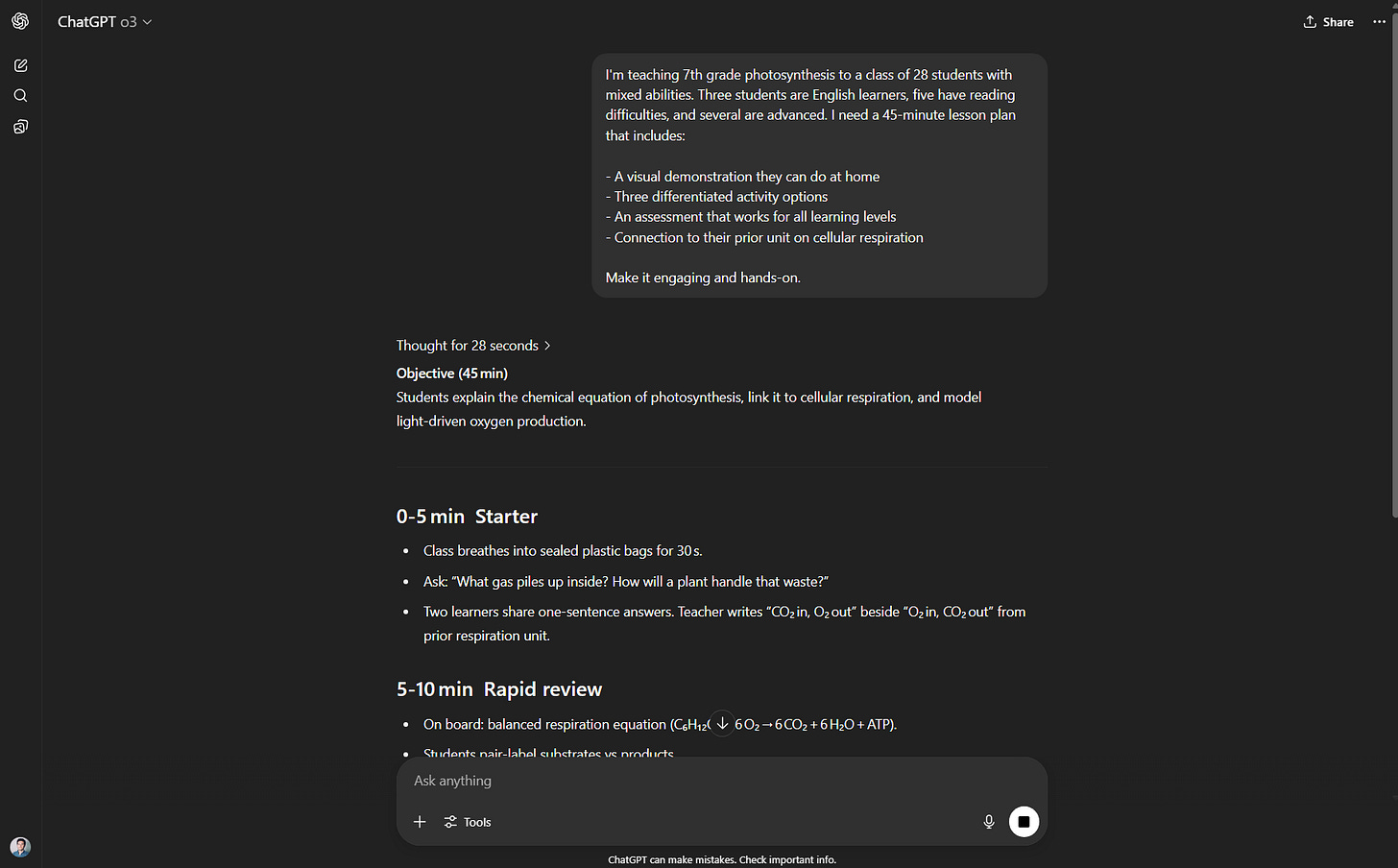
This specific prompt gives ChatGPT the context it needs to generate genuinely useful content rather than generic suggestions. Consider adding in specific challenges or expectations that you have with your class. Any specifics will help guide the model towards a more tailored and useful response.
2. Creating assessments and rubrics
AI can be excellent at generating varied question types and assessment criteria. For example:
Create a formative assessment for 9th grade students learning about the causes of World War I. Include:

- 5 multiple choice questions with common misconceptions as distractors
- 3 short answer questions requiring analysis
- One document-based question using a primary source
- A rubric that measures both historical thinking and content knowledge

Format this so I can easily import it into Google Forms.
Tweak the last bit depending on what software or platform you’re using to generate your docs.
3. Student communication and feedback
Use AI to help craft clear, constructive feedback or parent communications:
Help me write feedback for a student's persuasive essay. The essay argues for longer lunch periods. Strengths: clear thesis, good use of evidence from a survey they conducted. Areas for improvement: weak counterargument section, several grammar issues, conclusion doesn't fully connect back to introduction.

Tone should be encouraging but specific about next steps. Student is generally hardworking but struggles with confidence in writing.
If you’re dissatisfied with the tone of the writing, consider providing a sample of your language and instruct it to write the content in “your voice”. If you’re still not liking what you’re seeing, try the prompt in Anthropic’s Claude (typically heralded for its more natural-sounding copy).
Note: Your students can and will be using ChatGPT (whether its sneaking it in the classroom or logging on at home). Try not to think of this inevitability as a problem that needs eliminating. Instead, take note of AI’s ability to compliment your efforts and help provided furth individualized attention. Students now have access to AI tutors that never tire, provide instant feedback, and adjust difficulty in real time. AI-powered tools like Khanmigo and ChatGPT’s upcoming “study together” mode even allow interactive tutoring sessions that adapt to each student’s pace.