
Codex (just announced) is OpenAI’s opening bid to turn software engineering into an asynchronous, multi-agent activity.
Codex appears in ChatGPT’s sidebar as a cloud-hosted agent that spins up an isolated replica of your repo, writes code, runs tests, and submits pull-requests—while you watch a progress log crawl by in real time.
Under the hood is codex-1, a variant of the o3 reasoning model fine-tuned with reinforcement learning on real bugs, real test suites, and real human pull-requests. The result: patches that look like they came from a competent teammate rather than a language model.
Codex the tool
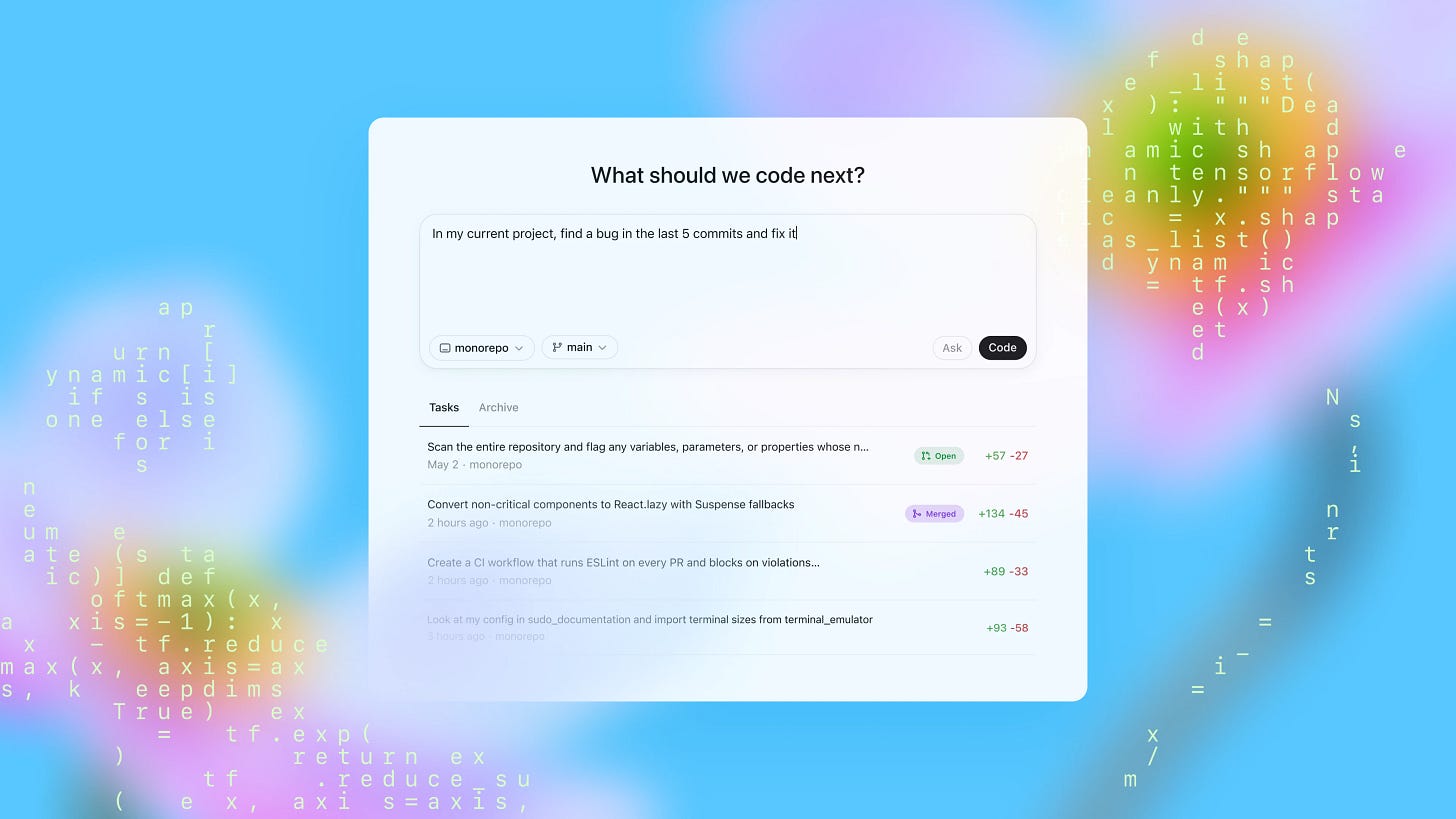
- An agent inside ChatGPT. Fire a prompt (“Refactor auth middleware”) and Codex shells into a sandbox, runs linter + unit tests, and only exits after the green bar lights up. Every terminal command and diff is cited so you can audit the run step-by-step.
- AGENTS.md guidance. Drop one in your repo to teach the agent project-specific rituals (custom test runners, code style quirks, CI flags). Think of it as a programmable persistent conscience for the model (similar to .cusorrules files).
- Codex CLI updates. An open-source terminal companion (
npm i -g @openai/codex) that pipes the same brains into your local workflow. It supports approval modes from suggest to full-auto, runs network-blocked, and can be scripted in CI pipelines. This was announced last month, but got model updates with this announcement. - Security posture. Every task runs in a locked-down container with outbound network disabled; policy tuning makes the agent loudly refuse malware prompts.
- Price and access. Free-while-it-lasts for Pro, Team, and Enterprise; API access to a trimmed
codex-mini-latestcosts $1.50/M input tokens after the honeymoon period.