Last week, I organized Nashville’s first official Cursor meetup. Would anyone show up? Would people actually have things to demo? Would the conversations be any good?
The answers: Yes. Way too many. And absolutely.
Here’s what happened, what I learned, and why I think these local AI communities matter more than most people realize.
The scene
We had over 10 presenters, with even more folks eager to get on the stage once the time was out. The fact that we had that many people eager to show off what they’d built says something about where we are in this AI moment. These weren’t all career developers with decades of experience (though some were). They were music industry professionals, entrepreneurs, hobbyists, and folks who six months ago couldn’t have told you what an IDE was.
Discussions ran past 9 PM. People didn’t want to leave. The networking conversations after the presentations were arguably more valuable than the presentations themselves, which is exactly what you want from a meetup (but also a sign that I need to tweak the format for next time).
The presentation that stuck with me
We saw a lot of impressive projects, but one stood out for what it represented rather than just what it did.
A local Nashville music industry manager, no formal coding background, walked us through his journey from absolute zero to building a sophisticated intelligent music mastering service. His progression tells a story that I think is becoming increasingly common:
- Stage 1: ChatGPT for Excel. He started by using ChatGPT to help with spreadsheet formulas. Practical, approachable, no intimidation factor. Just “help me figure out this VLOOKUP.”
- Stage 2: Curiosity creep. Once he realized AI could explain technical concepts in plain English, he started asking bigger questions. What if I could automate this? What if I could build a tool that does X?
- Stage 3: Cursor adoption. Eventually the ambition outgrew what ChatGPT’s code interpreter could handle. He needed to actually build something, with files, dependencies, APIs. So he downloaded Cursor.
- Stage 4: Shipping real software. A few months later, he’s standing in front of a room demonstrating a functional music mastering service called CYPHR that uses AI to analyze and process audio. The kind of thing that would have required hiring a team of developers not that long ago.
This is a prime example of the democratization of software development happening in real time. A music industry guy who just wanted to make better music tools.
Nashville isn’t Silicon Valley. We don’t have the same density of venture capital, engineering talent, or tech infrastructure. What we do have is a massive music industry full of creative professionals who understand their domain deeply but have historically been locked out of building the software tools they need.
That’s changing (and faster than you probably think).
The logistics
Nashville’s Cursor community is small, but from what I saw at the meetup, passionate and eager to grow. There will be many more Cursor meetups in the future, and I wanted to make sure I had a solid takeaway of what worked at this one (and what didn’t).
What worked
The raffle and Q&A integration. I built a simple event website (using Cursor!) that handled both the raffle entries and collected Q&A questions. This meant Austin could prep for questions ahead of time, and we didn’t have that awkward “…does anyone have any questions?” moment. People had already submitted what they wanted to know.
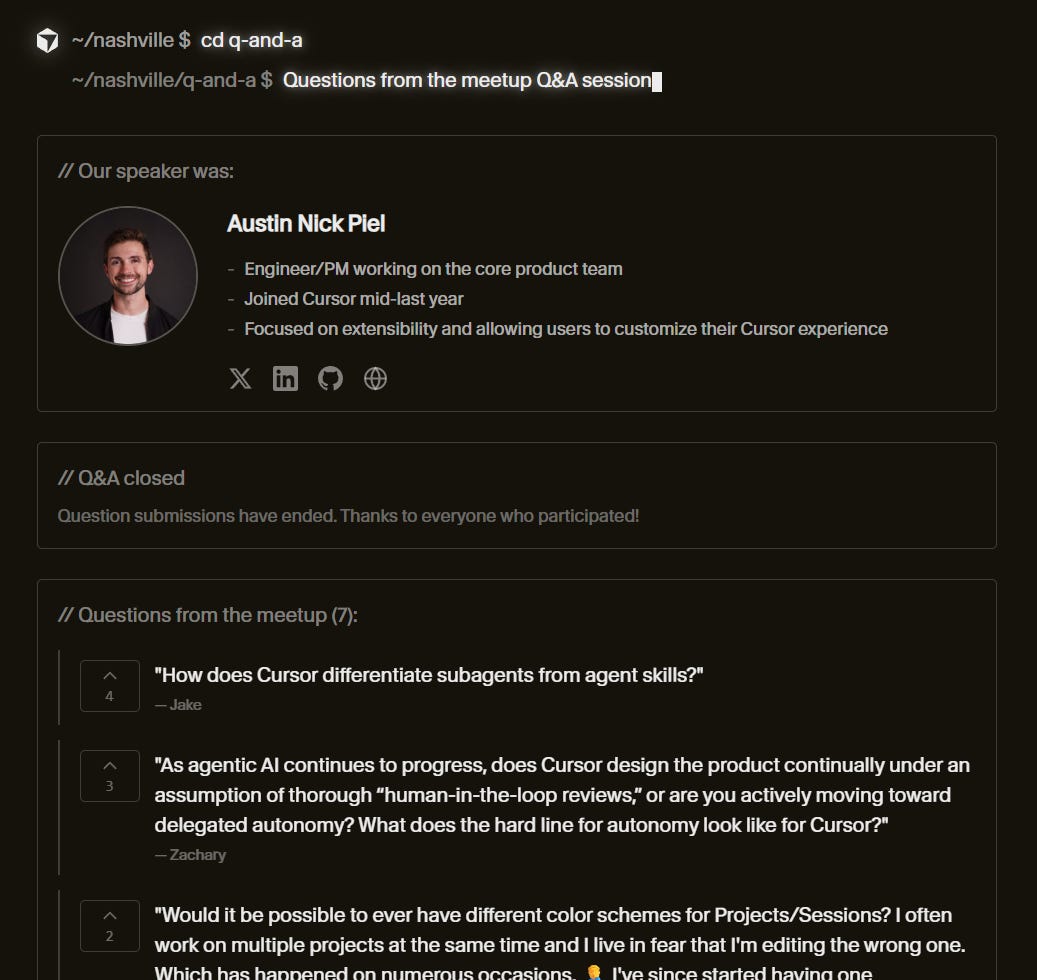
Bringing in someone from Cursor. Austin’s presence elevated the entire event. Having someone who actually builds the tool answer questions adds credibility and depth that a local organizer (me) can’t provide alone. If you’re organizing a meetup for any AI tool, reach out to the company. Many of them, Cursor included, have community programs and are eager to support grassroots events.
Catch this and more in the Handy AI newsletter.
The energy. Hard to quantify, but important. People were genuinely excited. The conversations were substantive. There’s something about being in a room with other people figuring out the same technology that you can’t replicate on Reddit or Discord.
What needs improvement
Too many presenters. Over ten was excessive. Each presentation was abbreviated, which meant nobody could go deep. Five is probably the right number. Maybe six if they’re disciplined. The goal should be depth over breadth, enough variety to showcase different use cases, but enough time for each presenter to actually explain their thinking, not just demo features.
Audio issues. The room was larger (well, longer) than I anticipated, and everyone spoke quietly. People in the middle and back couldn’t hear half the presentations. For the next event, we need microphones. This seems obvious in retrospect, but when you’re organizing your first meetup, you underestimate how much logistics matter.
Venue accessibility. We picked a downtown Nashville location, which sounds great until you remember that downtown Nashville on a weeknight means traffic headaches and parking that costs $25 if you can find it. We had strong registration numbers but a noticeable drop in actual attendance. Location matters. Next time I’ll be prioritizing easy access and free parking.
Raffle access. The QR code to access the raffle site should have been everywhere, projected on screens, printed on signs, stuck to tables. Instead, people had to hunt for it. Next time I’ll make sure any important links will be easily accessible on the official site, with no friction.
Why local matters in the current AI moment
Here’s what I keep thinking about after running this event.
AI tools are global. Cursor (and other tools like Claude Code and the newly announced Codex app) works the same whether you’re in San Francisco, Nashville, or Singapore. The documentation is online. The Discord servers are open to anyone. You can learn everything you need to know without ever leaving your house.
So why does a local meetup matter?
- Context. The music mastering demo made sense to the Nashville audience in a way it might not have in another city. The room understood the problem being solved because the room understood the industry. Local meetups let people see AI applications through the lens of their own professional context.
- Accountability. When you demo something in front of people you might run into at a coffee shop next week, you’re more motivated to actually finish it. This ghost deadline of “I’m presenting at the meetup next month” helps push these cool prototype projects out the door.
- Collision. The most interesting conversations I had were between people who would never have met otherwise. An infrastructure dev talking to a songwriter about data pipelines. A retired engineer explaining version control to someone who just learned what Cursor was three weeks ago. These collisions don’t happen online (because algorithmic feeds show you people who are already like you).
- Momentum. Building software alone is hard. Building software when you’re learning to build software is harder. Being in a room where everyone is figuring it out together normalizes the struggle and keeps people going. I watched several attendees exchange contacts with a “let’s help each other” energy that’s genuinely heartwarming.
AI coding tools are changing fast; it’s probably the space within the AI-industry-at-large that is on the verge of recursive improvements. The best practices don’t exist yet because the practices themselves are still emerging. Nobody has twenty years of experience in vibe coding because vibe coding is six months old. This means that a retired music executive experimenting with Cursor on weekends has insights that a professional developer might not have, and vice versa.
The knowledge graph for AI-assisted development is distributed across thousands of people trying things and sharing what works. Local meetups are nodes in that graph. They’re where tacit knowledge gets exchanged, where problems find solutions, where people who might have given up get the encouragement to keep going.
Cursor specifically has built something remarkable. Not just the tool itself (though clearly I’m a fanboy). They’ve built a community infrastructure that supports grassroots organizing. The Nashville meetup happened because Cursor makes it easy for folks like me to organize events, connect with official support, and bring in speakers who know the product deeply.
What’s next for Cursor Nashville
I’m already planning the second event, and based on what I heard in conversations, there are two directions that would fit this community well.
- Option A: Deep dive on Cursor usage. Instead of “show what you’ve built,” the format would be “show how you build.” Fewer presenters, longer sessions, focused on actual workflows. How do you structure your workspace? Should I be using Anthropic’s Claude 4.5 or OpenAI’s GPT-5.2 Codex? What’s your process when you’re stuck? This would serve the people who downloaded Cursor but haven’t figured out how to make it sing yet.
- Option B: Hackathon. Pick a problem, form teams, build for a day. This is higher commitment but creates the kind of intense learning experience that accelerates skill development. Nashville has interesting problems worth solving, plenty of them in music, healthcare, hospitality, logistics. A hackathon that focuses on local challenges could produce tools that actually matter to the community.
I’m leaning toward the hackathon format for the next event given the success of the builders at the meetup, but I’m genuinely open to feedback. If you’re in the Nashville area and have opinions, reach out.
Are you in Nashville and interested in the next meetup? Keep an eye on cursornashville.com for details on future events. And if you’re organizing a Cursor community in your own city, I’d love to hear about it.
Select any passage to give it a thumbs up or down. Humans and agents both welcome.